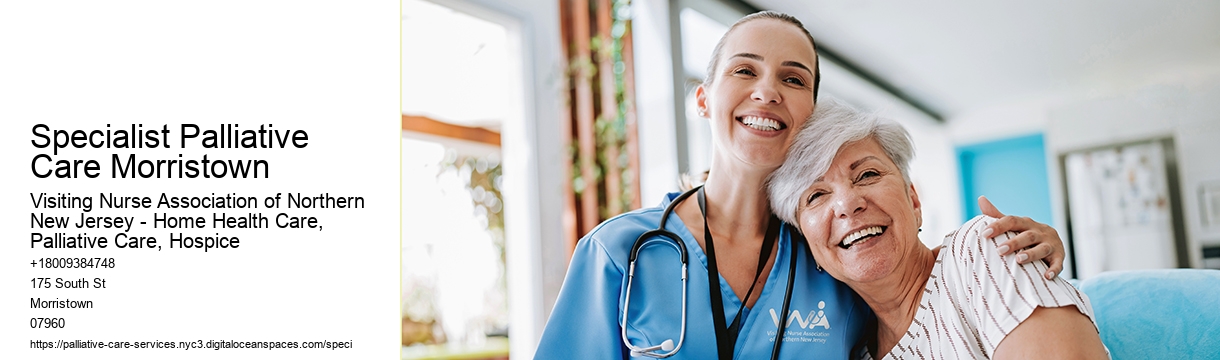
Specialist Palliative Care Morristown

Specialist Palliative Care Morristown

Supportive care for serious illness plays a vital role for individuals and families facing chronic conditions in Morristown, NJ and throughout Northern New Jersey. At Visiting Nurse Association of Northern New Jersey, care is centered on relief from symptoms and stress. Patients receive personalized attention designed to help them feel supported at every stage of illness, all while remaining in the comfort of their own home.

Palliative Care in Morristown NJ is not limited to end-of-life situations. It can be provided at any stage of illness. This approach allows individuals to focus on living well rather than constantly managing discomfort. Families often find that early involvement in comfort-oriented care reduces uncertainty and improves communication between healthcare providers and loved ones.

Receiving in-home comfort care allows patients to stay in familiar surroundings, surrounded by family and daily routines that bring reassurance. Instead of frequent hospital visits, care is delivered directly to the home, making the process feel supportive rather than disruptive. This home-centered approach supports both physical comfort and emotional well-being.

The palliative care team focuses on support for complex symptoms such as pain, shortness of breath, nausea, weakness, anxiety, and stress. Skilled nurses and care professionals work closely with physicians to ensure symptoms are managed effectively and care plans adapt as needs change. This coordinated approach helps patients experience fewer crises while navigating serious illness.

Senior comfort care services is especially valuable for older adults managing multiple health conditions. Aging patients often benefit from care that respects independence while providing reliable medical support. Home-based palliative care allows seniors to remain where they feel safest, supported by professionals who understand the unique challenges that come with aging and chronic illness.

Families also play a central role in family-centered care. Serious illness affects everyone involved, not just the patient. Caregivers often juggle responsibilities while coping with emotional stress. Palliative care teams offer guidance, education, and reassurance so families feel more confident and less alone. This shared approach helps reduce burnout and builds trust between patients, families, and providers.
supportive care for complex conditions focuses on helping patients understand their options clearly. Rather than rushing decisions, palliative care emphasizes thoughtful conversations and informed choices. Patients are encouraged to express their goals, preferences, and concerns so care aligns with what matters most to them. This patient-centered philosophy is a key reason many families choose local palliative care specialists.

In-home palliative care also supports smoother transitions between levels of care. Nursing care at home feels personal and reassuring. Whether someone is returning home after a hospital stay or managing a long-term condition, care coordination helps prevent gaps in treatment. Medication management, follow-up care, and symptom monitoring are handled with attention and clarity. This reduces confusion and helps families feel more prepared day to day.
community-based palliative care in Morristown NJ blend medical expertise with compassion. Care professionals do more than provide clinical services; they listen, explain, and respond with empathy. This human connection often makes a meaningful difference, especially during difficult moments when reassurance matters as much as treatment.

Patients receiving comfort-focused care often report improved quality of life. When symptoms are managed effectively, individuals can focus on meaningful activities, relationships, and rest. Even small improvements in comfort can lead to better sleep, improved mood, and greater independence, which collectively make everyday life more manageable.

End-of-life comfort care in Morristown is approached with sensitivity and respect. The goal remains the same: to support comfort, dignity, and peace. Families appreciate having a care team that communicates openly, responds quickly, and honors personal values during emotionally challenging times.

Local experience matters when choosing palliative care. Northern New Jersey palliative support reflect an understanding of the community and its healthcare landscape. Familiarity with local hospitals, physicians, and resources allows for smoother coordination and more personalized care experiences.

Throughout the palliative care journey, education plays a key role. Patients and families are given clear explanations about symptoms, medications, and what to expect next. This transparency reduces fear and helps people feel empowered rather than overwhelmed. Knowing what is happening and why can make even complex situations feel more manageable.

Choosing palliative care in Morristown NJ is about prioritizing quality of life. Morristown Holistic Palliative Care . It does not mean giving up hope or stopping treatment. Instead, it adds a layer of support that focuses on comfort, clarity, and compassion. Many families find that palliative care brings balance during uncertain times by addressing both medical needs and emotional well-being.

As needs change, palliative care adapts. Care plans are flexible and responsive, ensuring support remains appropriate at every stage. This adaptability allows patients and families to feel supported without feeling locked into rigid care structures. The focus remains on listening, adjusting, and responding with care.

For individuals and families in Morristown, NJ and across Northern New Jersey, palliative care services provide reassurance that they are not facing serious illness alone. With experienced professionals delivering care at home, patients can focus on what matters most while knowing help is always close by.

Palliative Care

Home Health Care


Hospice care is a sort of health care that focuses on the palliation (giving alleviation of discomfort) of a terminally sick individual's discomfort and symptoms and addressing their psychological and spiritual requirements at the end of life. Hospice care prioritizes convenience and lifestyle by minimizing discomfort and suffering. Hospice care supplies an alternate to therapies concentrated on life-prolonging steps that may be arduous, most likely to cause more signs and symptoms, or are not straightened with an individual's objectives. Hospice care in the USA is greatly defined by the methods of the Medicare system and various other medical insurance companies, which cover inpatient or at-home hospice look after individuals with incurable conditions that are estimated to live 6 months or less. Hospice care under the Medicare Hospice Advantage needs paperwork from 2 medical professionals approximating an individual has less than six months to live if the disease follows its typical course. Hospice advantages include accessibility to a multidisciplinary therapy group focused on end-of-life treatment and can be accessed in the home, lasting treatment facility or the health center. Outside the USA, the term often tends to be mainly related to the particular structures or institutions that focus on such treatment. Such establishments may similarly offer care primarily in an end-of-life setup, but they may additionally be offered for patients with various other palliative care needs. Hospice care consists of help for people' family members to assist them deal with what is taking place and offer treatment and assistance to maintain the patient in the house. The English word hospice is a borrowing from French. In France nonetheless, the word hospice refers more usually to an establishment where unwell and destitute people are looked after, and does not always have a palliative undertone.

.

Homecare (additionally referred to as home treatment, in-home care, care in your home, household care, personal care, area care, or social care) is health care or helpful care offered in the private home where the individual or customer is living, normally concentrating on paramedical aid by professional caretakers, help in everyday living for ill, disabled or elderly people, or a mix thereof. Depending on regulation, a wide range of various other solutions can likewise be included in homecare. Homecare can be organised by national or local government, by volunteer organizations or on a market basis.

.

Palliative care (from Latin root palliare "to cloak") is an interdisciplinary medical care-giving technique targeted at enhancing lifestyle and mitigating or minimizing suffering among people with severe, intricate, and commonly terminal diseases. Numerous meanings of palliative treatment exist. The World Wellness Organization (WHO) explains palliative care as: [A] n strategy that boosts the lifestyle of clients and their family members facing the issue related to life-threatening health problem, with the prevention and relief of suffering through early identification and impressive assessment and therapy of pain and other problems, physical, psychosocial, and spiritual. Since the 1990s, lots of palliative care programs involved a disease-specific method. However, as the field developed throughout the 2000s, the that started to take a more comprehensive patient-centered method that recommends that the principles of palliative care should be used as early as feasible to any persistent and inevitably deadly health problem. This shift was essential due to the fact that if a disease-oriented strategy is followed, the requirements and preferences of the individual are not fully fulfilled and facets of care, such as discomfort, lifestyle, and social support, in addition to spiritual and emotional demands, stop working to be resolved. Rather, a patient-centered model prioritizes relief of suffering and tailors like enhance the lifestyle for terminally sick clients. Palliative treatment is ideal for individuals with serious/chronic diseases across the age range and can be supplied as the primary goal of care or in tandem with curative treatment. It is preferably supplied by interdisciplinary groups which can consist of medical professionals, nurses, work and physical therapists, psychologists, social workers, chaplains, and dietitians. Palliative treatment can be provided in a selection of contexts, consisting of but not limited to medical facilities, outpatient centers, and home settings. Although a fundamental part of end-of-life care, palliative care is not restricted to people nearing end of life and can be valuable at any kind of phase of a complicated or chronic disease.

.

A persistent problem, also called chronic condition or chronic illness, is a health and wellness condition or disease that is persistent or otherwise lasting in its results or an illness that comes with time. The term persistent is usually applied when the course of the illness lasts for more than 3 months. Usual chronic diseases consist of diabetic issues, practical gastrointestinal disorder, eczema, arthritis, asthma, chronic obstructive lung condition, autoimmune illness, congenital diseases and some viral diseases such as hepatitis C and acquired immunodeficiency syndrome. A health problem which is lifelong since it ends in fatality is a terminal health problem. It is feasible and not unanticipated for a health problem to transform in definition from terminal to persistent as medication proceeds. Diabetes and HIV as an example were as soon as incurable yet are currently considered persistent, because of the schedule of insulin for diabetics and everyday medication therapy for individuals with HIV, which enable these people to live while managing symptoms. In medication, persistent problems are distinguished from those that are severe. An intense problem generally impacts one section of the body and responds to therapy. On the various other hand, a chronic problem usually impacts numerous areas of the body, is not completely responsive to therapy, and persists for an extensive amount of time. Persistent conditions may have periods of remission or regression where the condition momentarily vanishes, or consequently re-emerge. Periods of remission and regression are generally reviewed when describing chemical abuse problems which some think about to fall under the group of chronic problem. Persistent conditions are often associated with non-communicable diseases, which are differentiated by their non-infectious reasons. Some chronic conditions are caused by transmissible infections such as HIV/AIDS. 63% of all deaths worldwide are from chronic problems. Chronic illness comprise a major reason for mortality, and the World Health And Wellness Organization (THAT) associates 38 million deaths a year to non-communicable diseases. In the USA about 40% of grownups contend the very least two persistent problems. Having greater than one persistent condition is referred to as multimorbidity.

.

Occupational treatment (OT), likewise referred to as ergotherapy, is a medical care occupation. Ergotherapy is originated from the Greek ergon which is allied to work, to act and to be energetic. Work-related treatment is a health career that assists people take part in the day-to-day tasks, or line of work, that are necessary for life. These professions include self-care jobs, job, college, social engagement, and pastime. Physical therapists deal with individuals who experience illness, injury, special needs, or age-related adjustments that limit their capacity to function independently. They analyze a person’& rsquo; s requirements, established goals, and make use of daily tasks as healing devices. Specialists might additionally modify tasks, recommend adaptive tools, or readjust the physical or social setting to sustain engagement. Work-related treatment began turning into an official wellness occupation in the very early twentieth century. Work-related scientific research, the scholastic research study of humans as 'doers' or 'occupational beings', was established by interdisciplinary scholars, consisting of physical therapists, in the 1980s. The World Federation of Occupational Therapists (WFOT) defines work treatment as a "client-centred health and wellness occupation concerned with advertising health and wellness and health and wellbeing via profession. The key goal of work-related treatment is to enable people to participate in the activities of daily life. Occupational therapists achieve this outcome by dealing with people and areas to improve their capacity to take part in the professions they intend to, need to, or are anticipated to do, or by modifying the profession or the atmosphere to better sustain their work-related interaction. " Job-related therapy is classified as an allied wellness occupation in several nations. In the UK, occupational therapists are regulated by the Health and wellness and Treatment Professions Council as part of a team of professions that create the third-largest scientific workforce in the National Wellness Service. In England, allied health and wellness occupations (AHPs) are the third biggest scientific labor force in health and wellness and treatment. Fifteen careers, with 352,593 registrants, are controlled by the Wellness and Treatment Professions Council in the United Kingdom.

.

About Visiting Nurse Association of Northern New Jersey - Home Health Care

Photo
Photo

https://lh3.googleusercontent.com/places/ANXAkqGSFtpFzgLgkdP--qKRu47K531dAwRmp6I_Rv8k9hQmFdghTiGnJ0r-mT3EYHlPi0F0GPnBVyeTu1iDS5Ub924dLd5xe_ItOh8=s1600-w203

Reviews for Visiting Nurse Association of Northern New Jersey - Home Health Care


Visiting Nurse Association of Northern New Jersey - Home Health Care, 175 South St, Morristown, NJ 07960, USA

Scot Nourok

(5)

The care I received from my physical therapist was outstanding. Caring, with a sense of humor, which I appreciated, he guided me through the first two weeks of my physical therapy. I was in capable hands. He made sure I did just enough physical therapy to help me but not overdo it. I quickly advanced. I highlighly recommend VNA to anyone who needs physical therapy.

Visiting Nurse Association of Northern New Jersey - Home Health Care, 175 South St, Morristown, NJ 07960, USA

GH Again

(5)

Very friendly and compassionate staff. They seamlessly arranged in home physical therapy for me following my knee replacement surgery. The physical therapists were all very professional, experienced, and knowledgeable. They really helped in my speedy recovery.

Visiting Nurse Association of Northern New Jersey - Home Health Care, 175 South St, Morristown, NJ 07960, USA

Michele Babicz

(5)

Jeff was very helpful in my initial recovery. He was considerate of my pain level while gently pushing me to do my daily exercises. I highly recommend Jeff. He’s a great communicator and motivator.

Visiting Nurse Association of Northern New Jersey - Home Health Care, 175 South St, Morristown, NJ 07960, USA

Adrienne Lorenzen

(5)

VNA of Northern NJ has my highest praise for recognizing the excellent qualifications of their physical therapist Jennifer. I am blessed by her care. Jennifer is a unique combination of proffesional and personal. With her expertise and coaching, my journey to become functional again will be reality. Thanks for all you do Adrienne

https://www.google.com/maps/reviews/data=!4m8!14m7!1m6!2m5!1sCi9DQUlRQUNvZENodHljRjlvT2tWb1dVZEdNMHA1VjJSUmMySm1RbUl5WlZaR05XYxAB!2m1!1s0x0:0x6f0bee199d1ef78f!3m1!1s2@1:CAIQACodChtycF9oOkVoWUdGM0p5V2RRc2JmQmIyZVZGNWc%7C0d4q94j0w04%7C?hl=en-US

View GBP

About Visiting Nurse Association of Northern New Jersey - Home Health Care

Driving Directions in Morris County


Home Health Palliative Services NJ
40.733984099154, -74.400690059923
Starting Point
Visiting Nurse Association of Northern New Jersey - Home Health Care, 175 South St, Morristown, NJ 07960, USA
Destination
Open in Google Maps
In-Home Comfort Care Morris County NJ
40.681753009682, -74.374146917895
Starting Point
Visiting Nurse Association of Northern New Jersey - Home Health Care, 175 South St, Morristown, NJ 07960, USA
Destination
Open in Google Maps
Palliative Care Consultation Northern New Jersey
40.941539515982, -74.571883972882
Starting Point
Visiting Nurse Association of Northern New Jersey - Home Health Care, 175 South St, Morristown, NJ 07960, USA
Destination
Open in Google Maps
Serious Illness Care Northern New Jersey
40.682390123527, -74.476716012182
Starting Point
Visiting Nurse Association of Northern New Jersey - Home Health Care, 175 South St, Morristown, NJ 07960, USA
Destination
Open in Google Maps
Home Health Care
40.915995305846, -74.514252376899
Starting Point
Visiting Nurse Association of Northern New Jersey - Home Health Care, 175 South St, Morristown, NJ 07960, USA
Destination
Open in Google Maps
Home Palliative Support Northern New Jersey
40.671003842021, -74.501550405306
Starting Point
Visiting Nurse Association of Northern New Jersey - Home Health Care, 175 South St, Morristown, NJ 07960, USA
Destination
Open in Google Maps
Quality Of Life Care Northern New Jersey
40.893352058888, -74.263133100906
Starting Point
Visiting Nurse Association of Northern New Jersey - Home Health Care, 175 South St, Morristown, NJ 07960, USA
Destination
Open in Google Maps
Home Health Care Services
40.84740538239, -74.450845804203
Starting Point
Visiting Nurse Association of Northern New Jersey - Home Health Care, 175 South St, Morristown, NJ 07960, USA
Destination
Open in Google Maps
Palliative Care For Advanced Disease Morris County
40.599316106459, -74.397006599019
Starting Point
Visiting Nurse Association of Northern New Jersey - Home Health Care, 175 South St, Morristown, NJ 07960, USA
Destination
Open in Google Maps
Advanced Illness Care Morris County
40.917285353265, -74.502625357545
Starting Point
Visiting Nurse Association of Northern New Jersey - Home Health Care, 175 South St, Morristown, NJ 07960, USA
Destination
Open in Google Maps
Google Maps Location
https://www.google.com/maps/place/Visiting+Nurse+Association+of+Northern+New+Jersey+-+Home+Health+Care/@40.774616026488,-74.593408795716,25.2z/data=!4m6!3m5!1s0x89c3a697f9889a89:0x6f0bee199d1ef78f!8m2!3d40.7915613!4d-74.475933!16s%2F
Click below to open this location on Google Maps
Google Maps Location
https://www.google.com/maps/place/Visiting+Nurse+Association+of+Northern+New+Jersey+-+Home+Health+Care/@40.896007818114,-74.555896946955,25.2z/data=!4m6!3m5!1s0x89c3a697f9889a89:0x6f0bee199d1ef78f!8m2!3d40.7915613!4d-74.475933!16s%2F
Click below to open this location on Google Maps
Google Maps Location
https://www.google.com/maps/place/Visiting+Nurse+Association+of+Northern+New+Jersey+-+Home+Health+Care/@40.796515710103,-74.526648869125,25.2z/data=!4m6!3m5!1s0x89c3a697f9889a89:0x6f0bee199d1ef78f!8m2!3d40.7915613!4d-74.475933!16s%2F
Click below to open this location on Google Maps
Google Maps Location
https://www.google.com/maps/place/Visiting+Nurse+Association+of+Northern+New+Jersey+-+Home+Health+Care/@40.864937284625,-74.237992357707,25.2z/data=!4m6!3m5!1s0x89c3a697f9889a89:0x6f0bee199d1ef78f!8m2!3d40.7915613!4d-74.475933!16s%2F
Click below to open this location on Google Maps
Google Maps Location
https://www.google.com/maps/place/Visiting+Nurse+Association+of+Northern+New+Jersey+-+Home+Health+Care/@40.833061069055,-74.391207506751,25.2z/data=!4m6!3m5!1s0x89c3a697f9889a89:0x6f0bee199d1ef78f!8m2!3d40.7915613!4d-74.475933!16s%2F
Click below to open this location on Google Maps
Google Maps Location
https://www.google.com/maps/place/Visiting+Nurse+Association+of+Northern+New+Jersey+-+Home+Health+Care/@40.693016184492,-74.588138146503,25.2z/data=!4m6!3m5!1s0x89c3a697f9889a89:0x6f0bee199d1ef78f!8m2!3d40.7915613!4d-74.475933!16s%2F
Click below to open this location on Google Maps
Google Maps Location
https://www.google.com/maps/place/Visiting+Nurse+Association+of+Northern+New+Jersey+-+Home+Health+Care/@40.708688665921,-74.479227,25.2z/data=!4m6!3m5!1s0x89c3a697f9889a89:0x6f0bee199d1ef78f!8m2!3d40.7915613!4d-74.475933!16s%2F
Click below to open this location on Google Maps
Google Maps Location
https://www.google.com/maps/place/Visiting+Nurse+Association+of+Northern+New+Jersey+-+Home+Health+Care/@40.684702327759,-74.43618020698,25.2z/data=!4m6!3m5!1s0x89c3a697f9889a89:0x6f0bee199d1ef78f!8m2!3d40.7915613!4d-74.475933!16s%2F
Click below to open this location on Google Maps
Google Maps Location
https://www.google.com/maps/place/Visiting+Nurse+Association+of+Northern+New+Jersey+-+Home+Health+Care/@40.998331854889,-74.488797888497,25.2z/data=!4m6!3m5!1s0x89c3a697f9889a89:0x6f0bee199d1ef78f!8m2!3d40.7915613!4d-74.475933!16s%2F
Click below to open this location on Google Maps
Google Maps Location
https://www.google.com/maps/place/Visiting+Nurse+Association+of+Northern+New+Jersey+-+Home+Health+Care/@40.738852834981,-74.680276483184,25.2z/data=!4m6!3m5!1s0x89c3a697f9889a89:0x6f0bee199d1ef78f!8m2!3d40.7915613!4d-74.475933!16s%2F
Click below to open this location on Google Maps
Google Maps Location
https://www.google.com/maps/dir/?api=1&origin=40.915995305846,-74.514252376899&destination=Visiting+Nurse+Association+of+Northern+New+Jersey+-+Home+Health+Care%2C+175+South+St%2C+Morristown%2C+NJ+07960%2C+USA&destination_place_id=ChIJiZqI-Zemw4kRj_cenRnuC28&travelmode=walking&query=Home+Health+Care
Click below to open this location on Google Maps
Google Maps Location
https://www.google.com/maps/dir/?api=1&origin=40.634956210889,-74.603106625781&destination=Visiting+Nurse+Association+of+Northern+New+Jersey+-+Home+Health+Care%2C+175+South+St%2C+Morristown%2C+NJ+07960%2C+USA&destination_place_id=ChIJiZqI-Zemw4kRj_cenRnuC28&travelmode=driving&query=Palliative+Nursing+Care+Morris+County+NJ
Click below to open this location on Google Maps
Google Maps Location
https://www.google.com/maps/dir/?api=1&origin=40.75060100768,-74.666714622235&destination=Visiting+Nurse+Association+of+Northern+New+Jersey+-+Home+Health+Care%2C+175+South+St%2C+Morristown%2C+NJ+07960%2C+USA&destination_place_id=ChIJiZqI-Zemw4kRj_cenRnuC28&travelmode=bicycling&query=Palliative+Support+Services+Northern+New+Jersey
Click below to open this location on Google Maps
Google Maps Location
https://www.google.com/maps/dir/?api=1&origin=40.682390123527,-74.476716012182&destination=Visiting+Nurse+Association+of+Northern+New+Jersey+-+Home+Health+Care%2C+175+South+St%2C+Morristown%2C+NJ+07960%2C+USA&destination_place_id=ChIJiZqI-Zemw4kRj_cenRnuC28&travelmode=walking&query=Serious+Illness+Care+Northern+New+Jersey
Click below to open this location on Google Maps
Google Maps Location
https://www.google.com/maps/dir/?api=1&origin=40.733984099154,-74.400690059923&destination=Visiting+Nurse+Association+of+Northern+New+Jersey+-+Home+Health+Care%2C+175+South+St%2C+Morristown%2C+NJ+07960%2C+USA&destination_place_id=ChIJiZqI-Zemw4kRj_cenRnuC28&travelmode=transit&query=Home+Health+Palliative+Services+NJ
Click below to open this location on Google Maps
Google Maps Location
https://www.google.com/maps/dir/?api=1&origin=40.932003398605,-74.672059033851&destination=Visiting+Nurse+Association+of+Northern+New+Jersey+-+Home+Health+Care%2C+175+South+St%2C+Morristown%2C+NJ+07960%2C+USA&destination_place_id=ChIJiZqI-Zemw4kRj_cenRnuC28&travelmode=transit&query=Compassionate+Palliative+Care+Morristown
Click below to open this location on Google Maps
Google Maps Location
https://www.google.com/maps/dir/?api=1&origin=40.671003842021,-74.501550405306&destination=Visiting+Nurse+Association+of+Northern+New+Jersey+-+Home+Health+Care%2C+175+South+St%2C+Morristown%2C+NJ+07960%2C+USA&destination_place_id=ChIJiZqI-Zemw4kRj_cenRnuC28&travelmode=driving&query=Home+Palliative+Support+Northern+New+Jersey
Click below to open this location on Google Maps
Google Maps Location
https://www.google.com/maps/dir/?api=1&origin=40.640567680518,-74.618407030747&destination=Visiting+Nurse+Association+of+Northern+New+Jersey+-+Home+Health+Care%2C+175+South+St%2C+Morristown%2C+NJ+07960%2C+USA&destination_place_id=ChIJiZqI-Zemw4kRj_cenRnuC28&travelmode=transit&query=Palliative+Care
Click below to open this location on Google Maps
Google Maps Location
https://www.google.com/maps/dir/?api=1&origin=40.657865779728,-74.346579522306&destination=Visiting+Nurse+Association+of+Northern+New+Jersey+-+Home+Health+Care%2C+175+South+St%2C+Morristown%2C+NJ+07960%2C+USA&destination_place_id=ChIJiZqI-Zemw4kRj_cenRnuC28&travelmode=walking&query=Pain+And+Symptom+Management+Morristown+NJ
Click below to open this location on Google Maps
Google Maps Location
https://www.google.com/maps/dir/?api=1&origin=40.959715493804,-74.653415502665&destination=Visiting+Nurse+Association+of+Northern+New+Jersey+-+Home+Health+Care%2C+175+South+St%2C+Morristown%2C+NJ+07960%2C+USA&destination_place_id=ChIJiZqI-Zemw4kRj_cenRnuC28&travelmode=transit&query=End-Of-Life+Comfort+Care+Morristown
Click below to open this location on Google Maps

Frequently Asked Questions

Palliative care is specialized medical care that focuses on relieving pain, symptoms, and stress caused by serious or chronic illness. It helps patients feel more comfortable and supported while improving quality of life, regardless of the stage of illness or type of treatment they are receiving.

No. Palliative care is not limited to end-of-life situations. It can be provided at any stage of a serious illness and can be given alongside curative or life-prolonging treatments. Many patients benefit from palliative care early because it helps manage symptoms and reduce stress.

Yes. Palliative care can be delivered directly in the patient’s home throughout Morristown and Northern New Jersey. Home-based care allows patients to stay in familiar surroundings while receiving professional medical and emotional support.

A palliative care team typically includes experienced nurses, care coordinators, therapists, and medical social workers. The team works closely with the patient’s doctors to ensure care is well coordinated and tailored to individual needs.

Palliative care supports families by providing education, emotional guidance, and help with care planning. Caregivers receive reassurance and practical advice, which helps reduce stress and makes it easier to care for a loved one at home.

Palliative care helps manage a wide range of symptoms including pain, shortness of breath, fatigue, nausea, anxiety, depression, and difficulty sleeping. The goal is to reduce discomfort and improve daily functioning.

Palliative care may be helpful if symptoms are affecting daily life, hospital visits are becoming frequent, or emotional stress is increasing. Speaking with a healthcare provider or palliative care team can help determine if this type of support is appropriate.